Sustainable Entrepreneurial Intention: The Role of Competence, Mindset, and Self-Efficacy
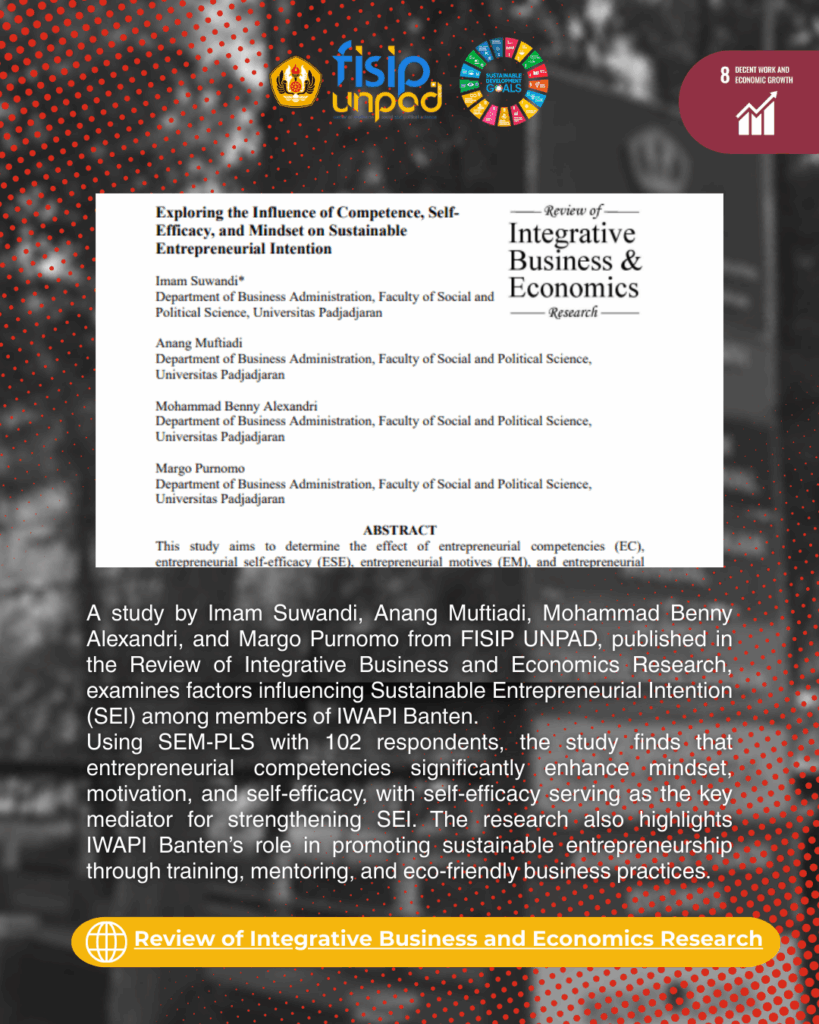
The Faculty of Social and Political Sciences (FISIP) of Universitas Padjadjaran, through its Department of Business Administration, has conducted an in-depth study titled “Exploring the Influence of Competence, Self-Efficacy, and Mindset on Sustainable Entrepreneurial Intention”, published in the Review of Integrative Business and Economics Research (Vol. 15, Issue 1, 2026). The research was led by Imam Suwandi, S.Sos., M.Si., along with a team of researchers: Dr. Anang Muftiadi, S.Sos., M.Si., Dr. Mohammad Benny Alexandri, S.E., M.Si., and Dr. Margo Purnomo, S.Sos., M.Si. The study focuses on exploring the factors influencing Sustainable Entrepreneurial Intention (SEI) among members of the Indonesian Women Entrepreneurs Association (IWAPI) of Banten Province. Involving 102 respondents from a total population of 512 IWAPI members, the research employed a random sampling method, with data collected through structured online questionnaires distributed via Google Forms and WhatsApp, as well as in-depth interviews with IWAPI Banten leaders to enrich the research context. Using the Structural Equation Modeling–Partial Least Squares (SEM-PLS) approach, the study analyzed the interrelationships among four key variables: Entrepreneurial Competencies (EC), Entrepreneurial Self-Efficacy (ESE), Entrepreneurial Mindset (EM), and Entrepreneurial Motives (EMo) in relation to SEI.
The findings indicate that entrepreneurial competencies significantly influence mindset, motivation, and self-efficacy, suggesting that the higher an entrepreneur’s competence, the better their mindset, motivation, and confidence in building a business. Interestingly, the study reveals that self-efficacy serves as the primary mediating factor in enhancing sustainable entrepreneurial intentions, while mindset and motivation alone do not directly affect SEI without strong confidence. The R-squared analysis shows that 57.6% of the variability in SEI can be explained by a combination of ESE, EM, and EMo, while the remaining variance is influenced by external factors beyond the study’s scope. Furthermore, the research highlights the critical role of IWAPI Banten in supporting sustainable entrepreneurship practices through various training programs, mentoring initiatives, and collaborative networking. Its members are actively involved in developing eco-friendly products and sustainable services, such as pandan-based handicrafts, beneng taro cultivation, and reusable healthcare products, aligning their efforts with the Sustainable Development Goals (SDGs), particularly SDG 5 (Gender Equality) and SDG 13 (Climate Action).
These findings underscore the importance of entrepreneurship education and competency-based training in enhancing the self-efficacy of women-owned micro, small, and medium enterprises (MSMEs). The study also provides strategic recommendations for governments, educational institutions, and business communities to strengthen an inclusive and sustainable entrepreneurial ecosystem. By fostering competence, cultivating a positive mindset, and building self-confidence, the research demonstrates that empowering women not only drives economic growth but also represents a concrete step toward achieving sustainable development.