https://www.scopus.com/pages/publications/85212980130
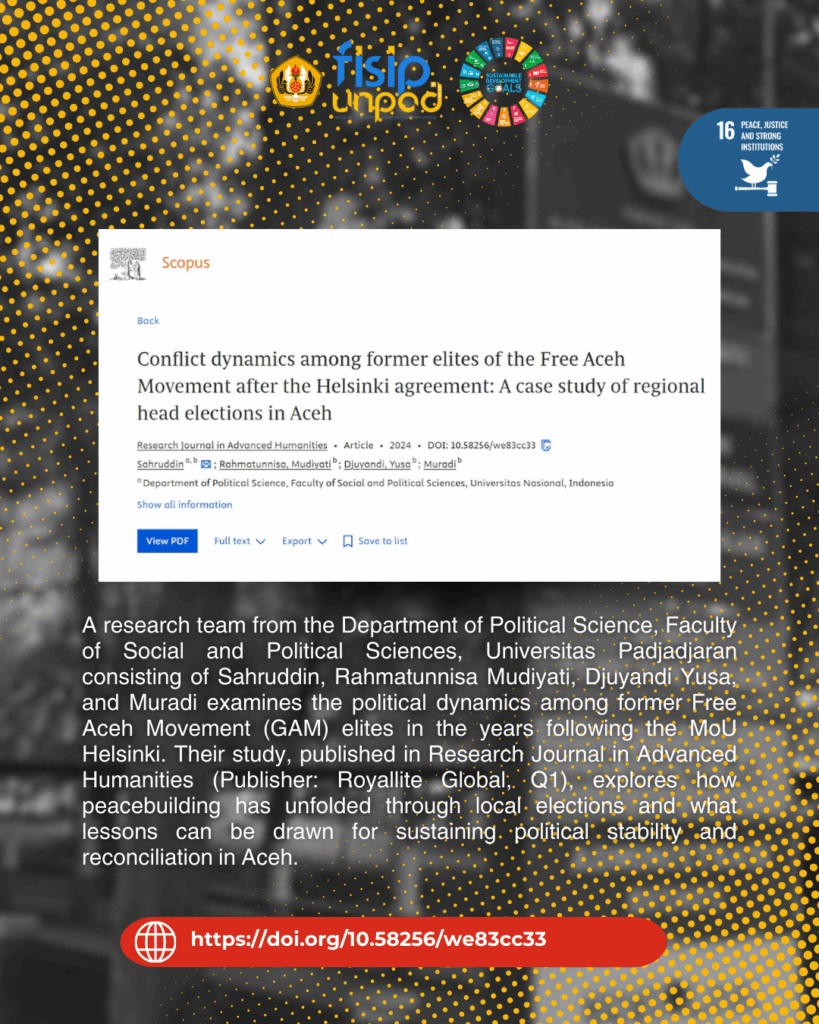
A research team from the Department of Political Science, Faculty of Social and Political Sciences, Universitas Padjadjaran consisting of Sahruddin, Rahmatunnisa Mudiyati, Djuyandi Yusa, and Muradi examines the political dynamics among former Free Aceh Movement (GAM) elites in the years following the MoU Helsinki. Their study, published in Research Journal in Advanced Humanities (Publisher: Royallite Global, Q1), explores how peacebuilding has unfolded through local elections and what lessons can be drawn for sustaining political stability and reconciliation in Aceh.
Using an exploratory case study approach, the researchers combined interviews and participatory observation with GAM elites, local politicians, conflict observers, and community leaders, supported by historical literature and treaty documents. The findings highlight the crucial role of the Helsinki Peace Agreement in ending armed conflict, facilitating demobilization and reintegration through the Aceh Transitional Committee (KPA), and enabling GAM’s transformation into a political force through Partai Aceh.
The study concludes that this transformation has significantly contributed to Aceh’s political stability and its integration into the Indonesian state. At the same time, internal dissent and continuing demands for broader autonomy illustrate that peace is not a finished product but a process requiring sustained dialogue, inclusive governance, and a firm commitment from all stakeholders.
Beyond its relevance for Aceh, the paper also speaks to Sustainable Development Goal (SDG) 16 on Peace, Justice, and Strong Institutions. By showing how post-conflict regions can strengthen democracy through inclusive political participation and resilient institutions, the research provides lessons on how to build peace that endures.
DOI: 10.58256/we83cc33