
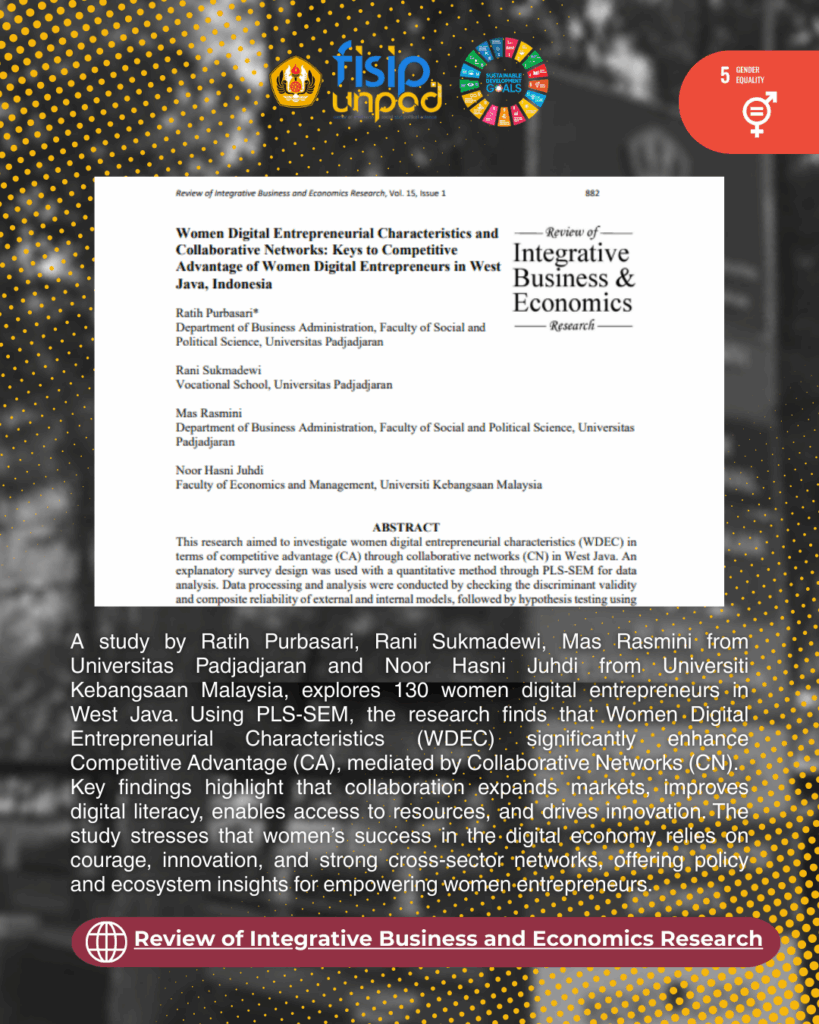
Building Resilient Digital Businesses: Key Findings on Women Entrepreneurs in West Java
Behind the screens of Instagram, online marketplaces, and financial technology platforms lie the inspiring stories of West Java’s women entrepreneurs who have dared to break through limitations. They started their businesses from scratch, harnessing digital technologies and building collaborative networks to survive and thrive in an increasingly competitive market.
These insights come from a groundbreaking study conducted by Universitas Padjadjaran in collaboration with Universiti Kebangsaan Malaysia. The research was led by Dr. Ratih Purbasari from the Department of Business Administration, FISIP Unpad, alongside Dr. Rani Sukmadewi from Unpad’s Vocational School, Dr. Mas Rasmini from FISIP Unpad, and Dr. Noor Hasni Juhdi from the Faculty of Economics and Management, Universiti Kebangsaan Malaysia. Supported by the Research and Community Service Directorate of Universitas Padjadjaran under the 2024 Unpad Lecturer Competency Research Scheme, the study involved 130 women digital entrepreneurs registered in communities such as Tangan Di Atas (TDA) Bandung, IWAPI, and ABDSI West Java. West Java was selected as the research site because it ranks as a leading digital province in Indonesia, achieving a score of 57.14 in the East Ventures Digital Competitiveness Index (EV-DCI) 2021, highlighting its strong potential in digital human resources. Using the Partial Least Squares Structural Equation Modeling (PLS-SEM) method, the study revealed that Women Digital Entrepreneurial Characteristics (WDEC) have a significant impact on Competitive Advantage (CA), both directly and indirectly, through Collaborative Networks (CN) as a mediating factor.
The findings show that collaborative networks create opportunities for women digital entrepreneurs to expand their markets, improve technological literacy, access funding and resources, and foster business innovation. The study also underscores the importance of synergy between courage, innovation, and collaboration in shaping resilient women entrepreneurs in today’s digital economy. Beyond enriching the academic literature on digital entrepreneurship, the research offers strategic recommendations for local governments, educational institutions, and business communities to strengthen the digital entrepreneurship ecosystem for women in West Java. The research team emphasizes that success in the digital era cannot be achieved alone; it requires cross-sector collaborative networks that empower women entrepreneurs to sustain, grow, and compete effectively in both local and global markets.