https://www-scopus-com.unpad.idm.oclc.org/pages/publications/85209932117
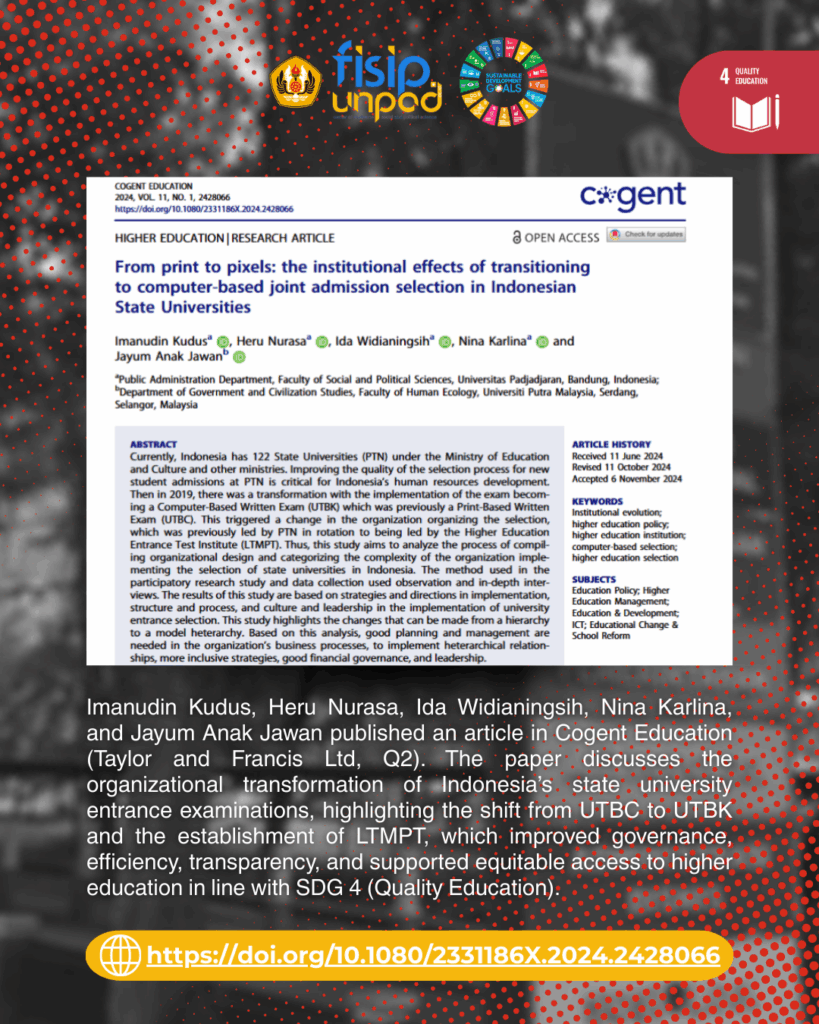
A research team led by Imanudin Kudus, Heru Nurasa, Ida Widianingsih, Nina Karlina, and Jayum Anak Jawan has conducted a significant study analyzing the organizational transformation behind Indonesia’s state university entrance examinations. With 122 State Universities (PTN) under the Ministry of Education and Culture and other ministries, improving the quality of student admission is crucial for advancing the nation’s human resources. This study has been published in Cogent Education (Publisher: Taylor and Francis Ltd) and is indexed in Q2.
In 2019, the selection system shifted from the traditional Print-Based Written Exam (UTBC) to the Computer-Based Written Exam (UTBK), accompanied by the restructuring of the organizing body from rotating leadership among universities to the establishment of the centralized Higher Education Entrance Test Institute (LTMPT).
Through participatory research involving observations and in-depth interviews, the study explored how organizational design and complexity were managed in this transformation. The findings highlight a shift from rigid hierarchical models toward more flexible heterarchical structures, enabling inclusive strategies, stronger financial governance, and adaptive leadership. By improving governance and institutional design in the admissions process, this transformation not only enhances efficiency and transparency but also advances the goals of SDG 4 (Quality Education) by expanding equitable access to higher education and strengthening the foundation for future-ready human resources in Indonesia.