
https://www.scopus.com/pages/publications/105001077842
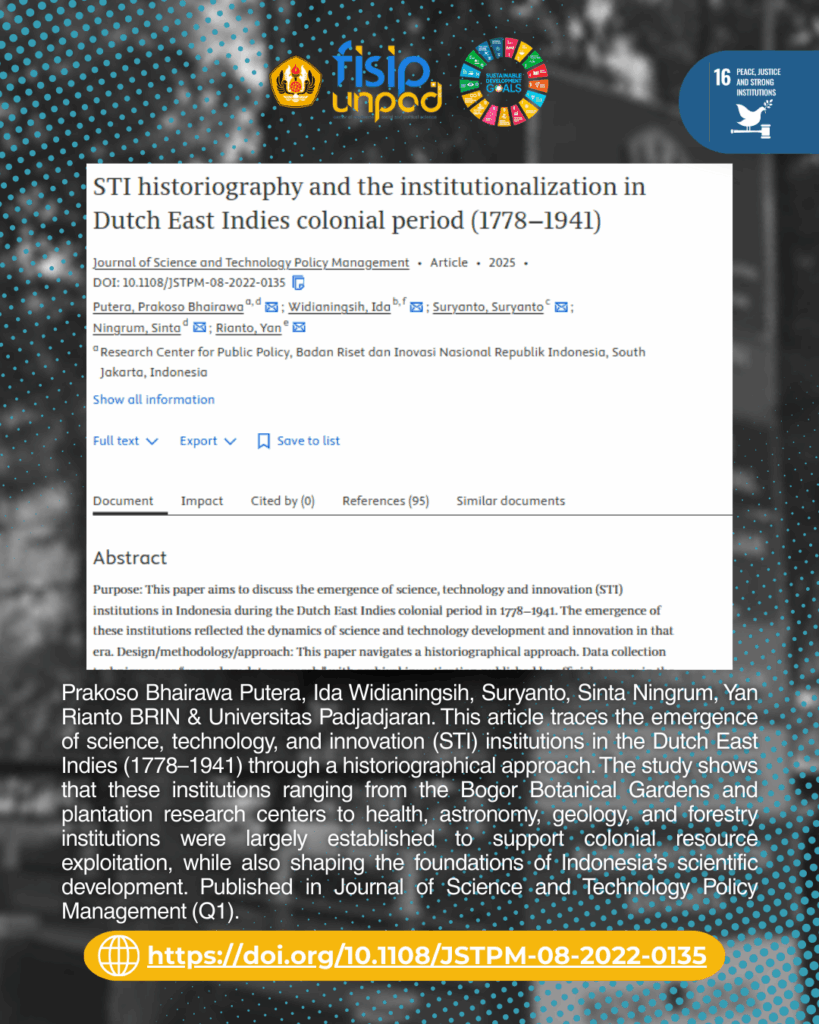
Authors: Prakoso Bhairawa Putera; Ida Widianingsih; Suryanto; Sinta Ningrum; Yan Rianto — BRIN & Universitas Padjadjaran.
This article examines the rise of science, technology, and innovation (STI) institutions in the Dutch East Indies between 1778 and 1941, reflecting the dynamics of scientific and technological development in the colonial era. Employing a historiographical approach and relying on secondary archival data from the 18th and 19th centuries, the study reconstructs the institutional evolution of STI in Indonesia.
The findings indicate that STI institutions were primarily established to maximize the exploitation of natural resources in the Dutch East Indies. These included:
1. Units/institutions established as part of Plantentuin Buitenzorg (Bogor Botanical Gardens),
2. Plantation-based institutions addressing crop pests and diseases,
3. Health sector institutions,
4. Astronomy, geology, and forestry-based institutions,
5. Scientific councils and professional associations.
As one of the first studies of its kind, this research highlights the clustering of five STI institutional types during the colonial era and offers a valuable historical perspective on science and innovation governance in Indonesia. It is directly relevant to SDG 16 (Peace, Justice, and Strong Institutions).