https://www.scopus.com/pages/publications/85214477102
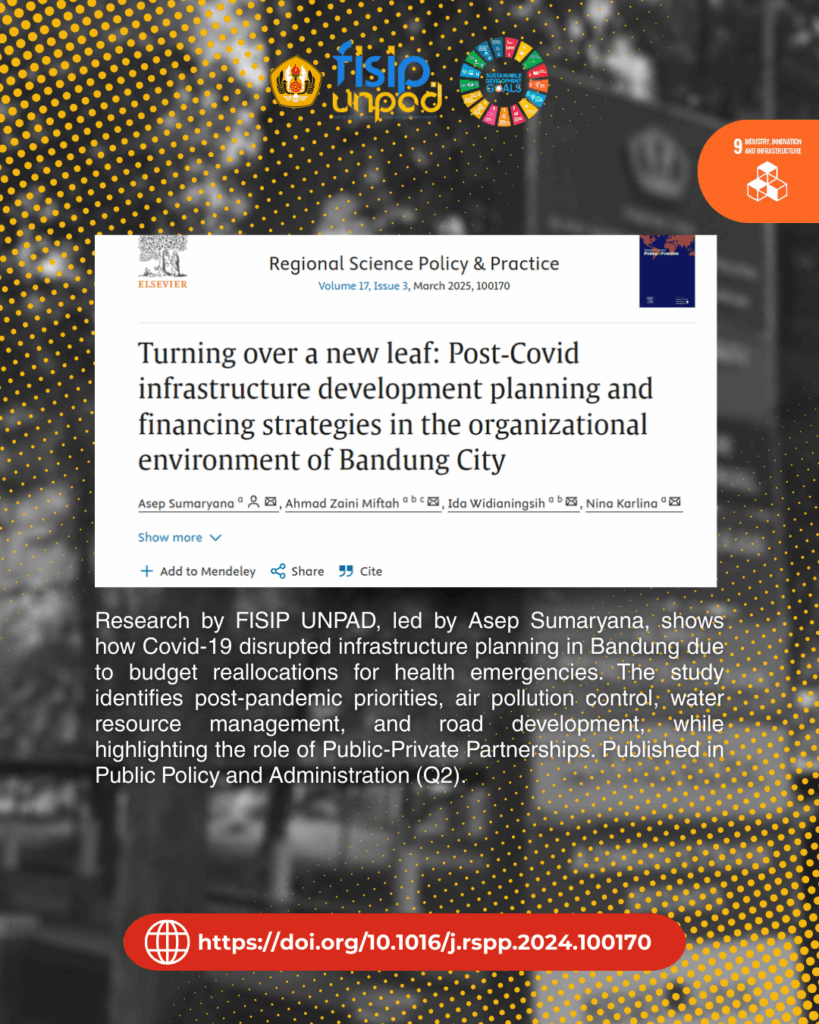
Authors: Asep Sumaryana; Ahmad Zaini Miftah; Ida Widianingsih; Nina Karlina — Faculty of Social and Political Sciences, Universitas Padjadjaran.
This article addresses the significant impact of the Covid-19 pandemic on infrastructure planning and development in Bandung City. During the pandemic, government investments in infrastructure were drastically reduced due to budget reallocations for health emergency responses, even though infrastructure remains a critical foundation for daily life and state administration.
The research investigates the 2018–2023 Bandung City Medium-Term Development Plan (RPJMD) in the context of Covid-19, aiming to identify indicators and priority programs for post-pandemic infrastructure. Employing Regulatory Gap Analysis (RGA) and the Analytical Hierarchy Process (AHP), the study ranked development priorities through a systematic evaluation of criteria selection, program structuring, pairwise comparisons, and weighted scoring.
Findings reveal three key priority programs:
- Air pollution control and climate change adaptation programs,
- Water resources facilities and infrastructure management programs,
- Road development and infrastructure management programs.
Beyond reliance on the Local Government Budget (APBD), the study emphasizes the potential of Public-Private Partnership (PPP) schemes to share risks between government and private sectors. In Bandung, PPP models have been applied in several infrastructure projects, including public street lighting, urban parks, factory outlets, cafés, and recreation centers.
The article contributes a practical framework for sustainable financing and infrastructure resilience in the post-Covid era, aligned with SDG 9 (Industry, Innovation & Infrastructure).