
https://www.scopus.com/pages/publications/85219571516
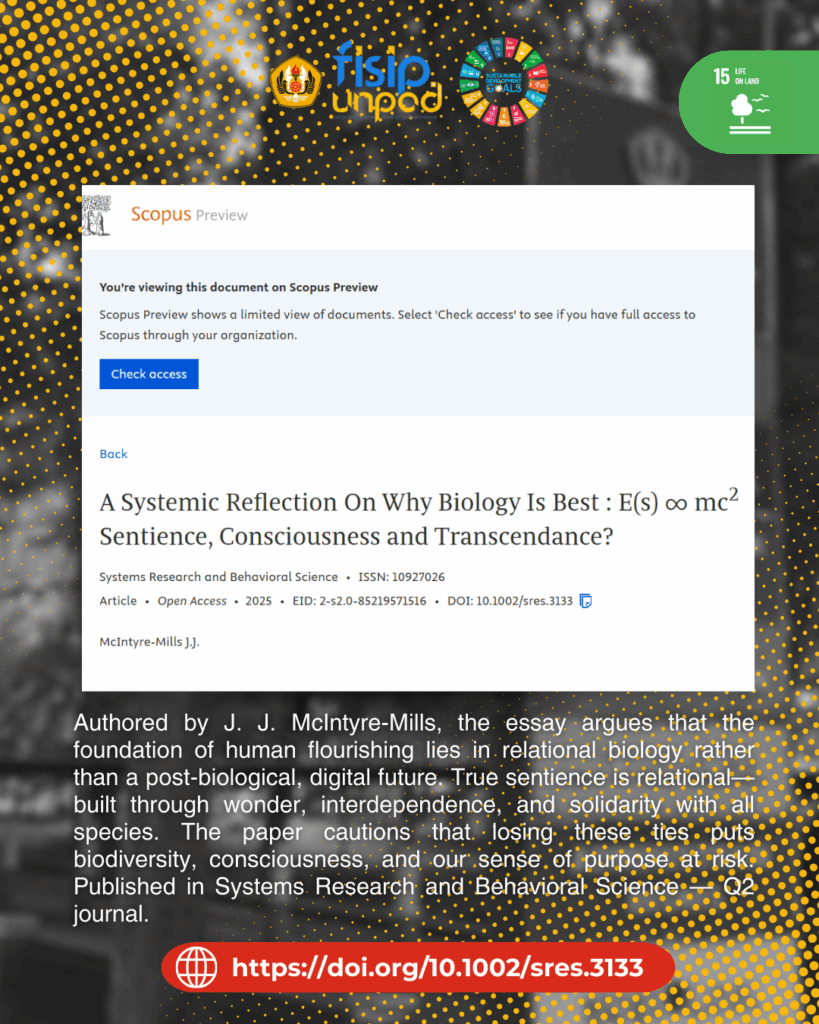
In her article A Systemic Reflection On Why Biology Is Best: E(s)∞mc2 Sentience, Consciousness and Transcendence?, J. J. McIntyre-Mills argues that the foundation of human survival and flourishing lies not in abandoning biology for digital futures, but in deepening our relational ties with one another, with other species, and with the ecosystems we share.
The article challenges the notion of a “post-biological” world where humans evolve into hybrid digital beings. Instead of progress, McIntyre-Mills describes such a trajectory as devolution—an unraveling of the very relationships that sustain life. True sentience, she contends, is relational. It arises from awe, wonder, and interconnection with the living and non-living world around us. When those ties are severed, humanity risks losing not only biodiversity, but also its own consciousness and sense of purpose.
Drawing from Indigenous knowledge systems, neuroscience, and ecological philosophy, the article highlights that consciousness may not be unique to humans alone. Plants, animals, and even so-called inanimate matter embody forms of awareness and relational energy. Respecting these forms of sentience demands solidarity with the voiceless—protecting species and habitats not only as a moral imperative, but also as a pragmatic necessity. When other species suffer, humanity ultimately suffers as well, as seen in pandemics and ecological crises rooted in habitat destruction and commodification of life.
McIntyre-Mills calls for a reinvention of democracy and governance that acknowledges interdependence across species and generations. She urges us to embrace an “ecology of mind” that honors kinship with nature, protects biodiversity, and rejects the illusion that technology alone can shield us from ecological collapse. Protecting biological life is, in essence, protecting ourselves.
At its heart, the article is both a warning and an invitation: a warning against the hubris of commodifying life and privileging digital futures over natural ones, and an invitation to reimagine our systems of thought and governance around solidarity, stewardship, and sustainability.
By affirming that “biology is best,” McIntyre-Mills reminds us that climate action and social justice are inseparable from the defense of life in all its forms. Her reflections align directly with Sustainable Development Goal 13: Climate Action, reinforcing the urgency of nurturing the planet as the shared home of humanity and all species.