
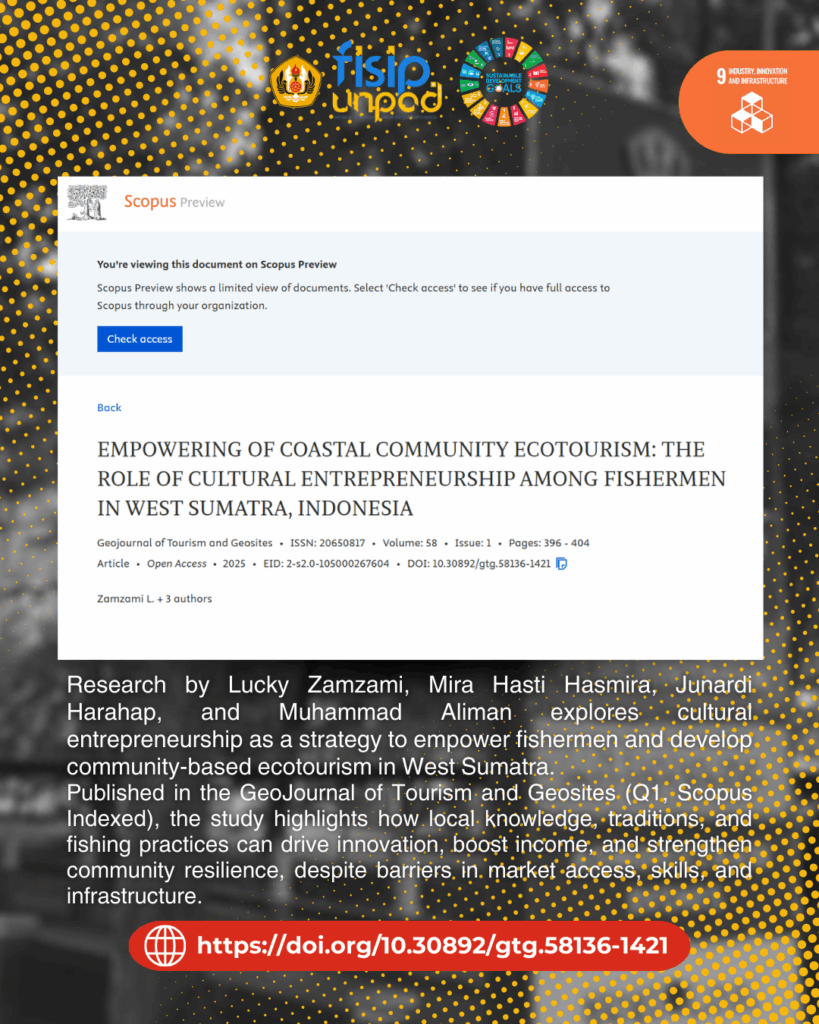
https://www.scopus.com/pages/publications/105000267604
Coastal communities are often faced with dual challenges: economic vulnerability and cultural preservation. In many regions, including West Sumatra, fishermen are traditionally seen only as producers of fishery products. However, entrepreneurship development in the fisheries sector is increasingly recognized as a crucial tool for poverty alleviation, sustainable livelihoods, and social empowerment.
This study, conducted in Tiku Selatan Village, Tanjung Mutiara Regency, West Sumatra, Indonesia, explores the application of cultural entrepreneurship as a transformative approach for fishermen and their families. Cultural entrepreneurship refers to the use of local knowledge, traditions, and cultural heritage as key resources to create innovative and community-driven economic activities. In this context, ecotourism becomes a vital pathway where local traditions, fishing practices, and natural resources are integrated to foster socio-economic progress while safeguarding cultural identity.
The research employed a qualitative approach, combining in-depth interviews, focus group discussions, and observations. Respondents included fifteen fishermen, ten women (mostly fishermen’s wives), and local government representatives. The findings highlight the ability of fishermen to leverage traditional skills and local resources to generate added value beyond fish production. This entrepreneurial shift has led to improved household income and strengthened community resilience.
However, several barriers were identified. Limited market access, insufficient entrepreneurial skills, and lack of supportive infrastructure currently hinder the full realization of cultural entrepreneurship’s potential. Despite these challenges, the study reveals that when linked with ecotourism and social entrepreneurship, cultural entrepreneurship can serve as a strategic driver for:
1. Enhancing economic resilience in coastal villages,
2. Preserving cultural identity and local traditions,
3. Building innovative and creative models of village development,
4. Supporting long-term sustainability goals.
In conclusion, empowering fishermen through cultural entrepreneurship and ecotourism represents more than an economic strategy, it is a holistic approach that links social welfare, cultural sustainability, and environmental stewardship. This initiative directly supports the achievement of Sustainable Development Goal (SDG) 13: Climate Action, as well as broader goals related to poverty reduction and sustainable communities.
This article was written by Lucky Zamzami, Mira Hasti Hasmira, Junardi Harahap, and Muhammad Aliman.