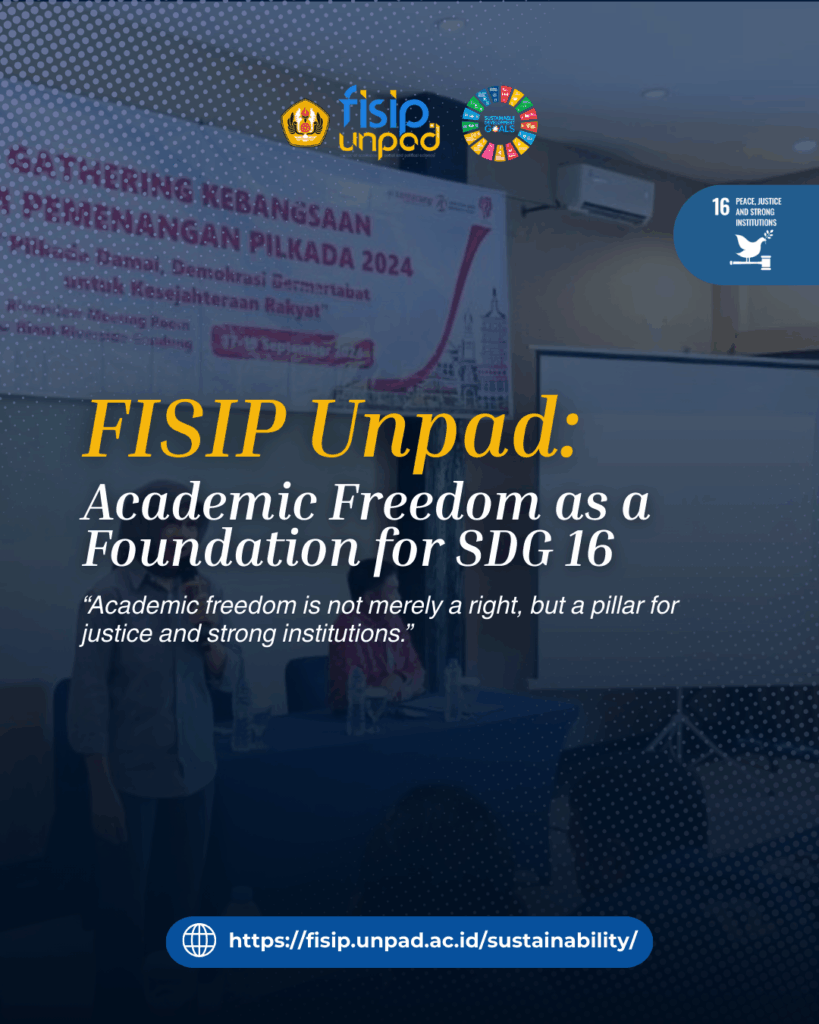
At the Faculty of Social and Political Sciences (FISIP) Unpad, academic freedom is not merely a right but a fundamental pillar supporting the entire mission of higher education. This value serves as a cornerstone of the faculty’s commitment to achieving Sustainable Development Goal 16 (SDG 16): Peace, Justice, and Strong Institutions.
This principle is formally protected within the Guideline on the Lecturer’s Code of Ethics at Universitas Padjadjaran. This framework guarantees lecturers the freedom to advance science through research and teaching, as well as the liberty to express thoughts and opinions within academic forums based on intellectual honesty. Crucially, this freedom extends to a core responsibility: lecturers are obligated to protect and encourage their students’ right to learn freely, fostering an environment that cultivates freedom of thought, rationality, and the ability to critically question and analyze ideas.
This commitment is actively implemented through various activities that demonstrate the proactive role of FISIP lecturers as agents of change and experts in their fields. The following are tangible examples of how this academic freedom is put into practice:
- Disseminating Knowledge in the Public Sphere: FISIP lecturers consistently serve as speakers at various public events and media outlets. They boldly address critical issues ranging from “The Development of IKN and Its Impact on Equitable Distribution” to “Is the Use of Private Funds for Government Programs Ethical?” Their presence on national television networks like TVRI and radio stations like MQFM showcases how academics use these platforms to present honest, research-based analysis to the wider community.
- Analyzing Crucial Social Issues: Through events such as “SEMESTA (Social Movement Through Art),” lecturers dissect sensitive issues like child marriage and the exploitation of children from the perspectives of social welfare and public policy. This event creates a safe space for students and the public to engage in critical discourse, demonstrating how academic freedom is leveraged to analyze social inequities and seek solutions.
3.Advancing Science Through Collaboration and Research: FISIP lecturers actively participate in national and international seminars, including the “National Seminar on the Adaptation of Administrative Science in the Development of Artificial Intelligence” and the “National Seminar with Community Leaders.” This involvement not only enriches their insights but also highlights the freedom lecturers have in choosing their research fields and presenting their findings in relevant forums, both within academia and for the public.
By upholding these values, FISIP Unpad directly implements key facets of SDG 16. It strengthens institutions by enabling critical inquiry that holds societal structures accountable, promotes justice by providing a safe space to analyze social inequities, and helps ensure public access to reliable information by protecting the researcher’s duty to seek and state the truth. Thus, academic freedom at FISIP is a vital mechanism for fulfilling the university’s role as an agent of change, actively contributing to a more just and knowledgeable society.