
https://www-scopus-com.unpad.idm.oclc.org/pages/publications/105001623612
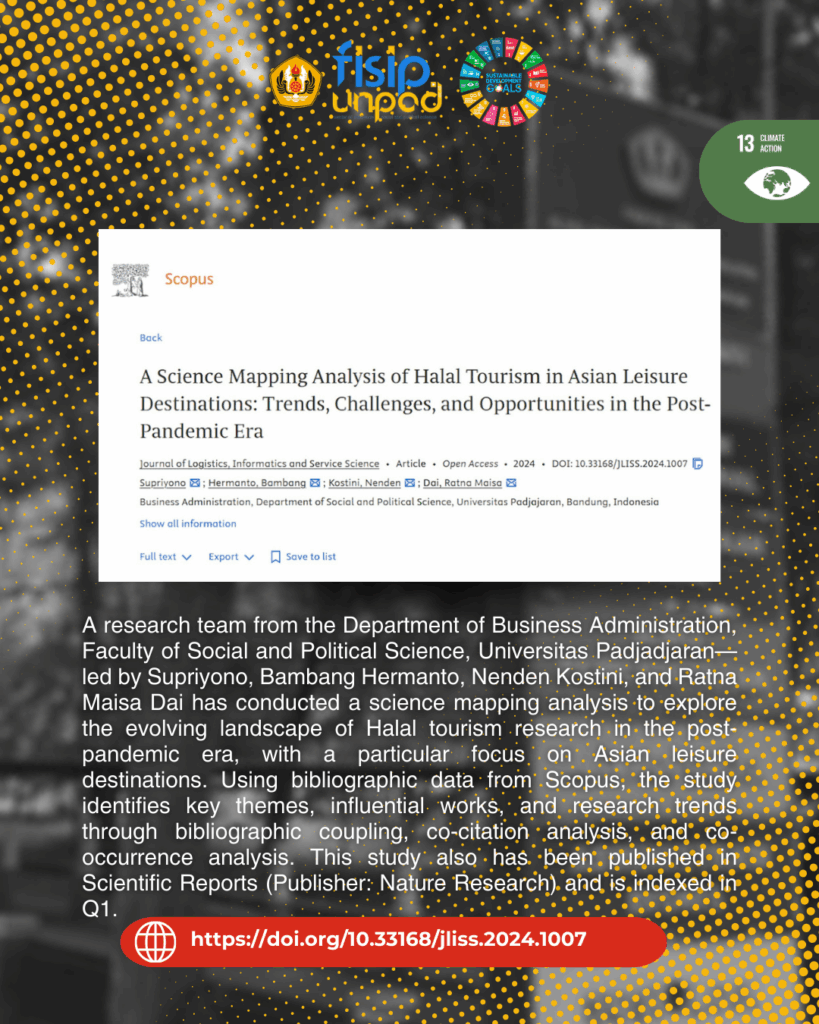
A research team from the Department of Business Administration, Faculty of Social and Political Science, Universitas Padjadjaran—led by Supriyono, Bambang Hermanto, Nenden Kostini, and Ratna Maisa Dai has conducted a science mapping analysis to explore the evolving landscape of Halal tourism research in the post-pandemic era, with a particular focus on Asian leisure destinations. Using bibliographic data from Scopus, the study identifies key themes, influential works, and research trends through bibliographic coupling, co-citation analysis, and co-occurrence analysis. This study also has been published in Scientific Reports (Publisher: Nature Research) and is indexed in Q1.
The findings highlight the growing significance of Halal tourism and its interconnectedness with broader tourism dynamics, while also pointing to emerging themes such as the role of digital platforms, the rise of experiential tourism, and the integration of sustainable practices. These insights underscore the rapid transformation of Halal tourism as both an academic field and an industry sector.
Importantly, the study provides recommendations for scholars, practitioners, and policymakers to address challenges and leverage opportunities in this dynamic sector. By fostering innovation, inclusivity, and sustainability, Halal tourism can continue to expand its relevance and contribute to the future of global tourism.
Beyond its contributions to the tourism industry, this research also aligns with Sustainable Development Goal (SDG) 13: Climate Action. By emphasizing sustainability and encouraging environmentally conscious practices within Halal tourism, the study highlights how the sector can reduce its ecological footprint, promote responsible resource management, and support global efforts to mitigate climate change. In this way, Halal tourism is positioned not only as an engine for economic growth but also as a driver of climate resilience and sustainable development.
DOI: 10.33168/JLISS.2024.1007