
https://www-scopus-com.unpad.idm.oclc.org/pages/publications/85206078364
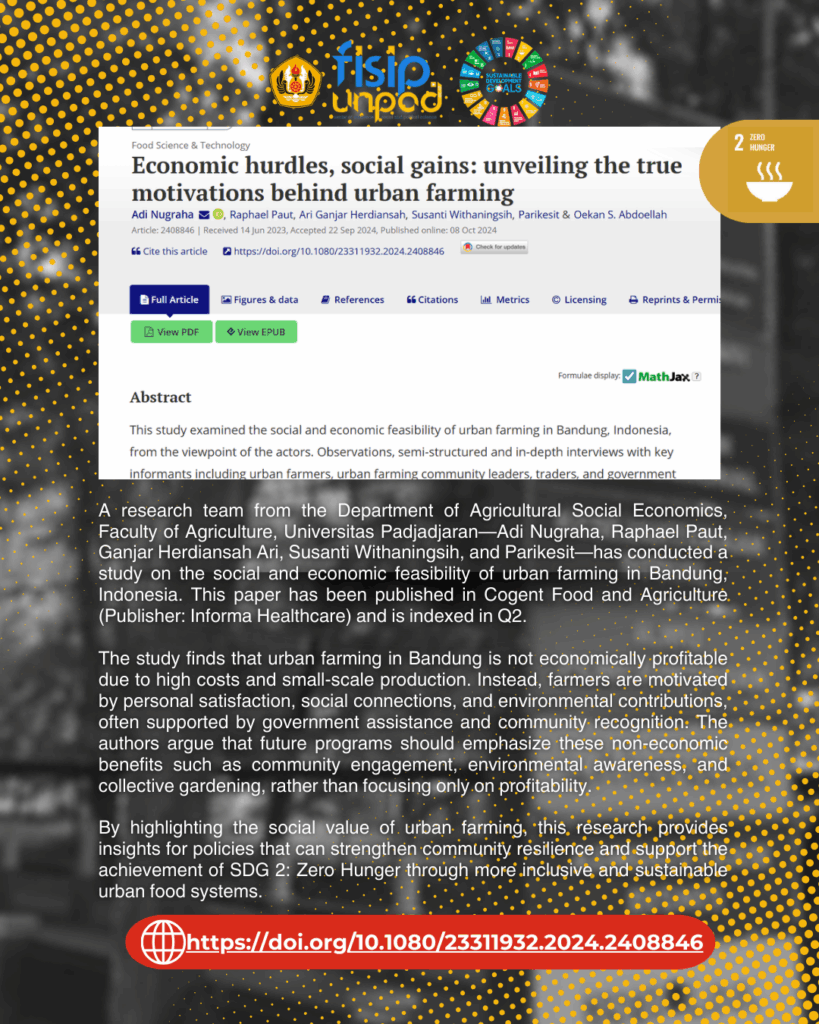
A research team from the Department of Agricultural Social Economics, Faculty of Agriculture, Universitas Padjadjaran—Adi Nugraha, Raphael Paut, Ganjar Herdiansah Ari, Susanti Withaningsih, and Parikesit—has conducted a study on the social and economic feasibility of urban farming in Bandung, Indonesia. This paper has been published in Cogent Food and Agriculture (Publisher: Informa Healthcare) and is indexed in Q2.
The study finds that urban farming in Bandung is not economically profitable due to high costs and small-scale production. Instead, farmers are motivated by personal satisfaction, social connections, and environmental contributions, often supported by government assistance and community recognition. The authors argue that future programs should emphasize these non-economic benefits such as community engagement, environmental awareness, and collective gardening, rather than focusing only on profitability.
By highlighting the social value of urban farming, this research provides insights for policies that can strengthen community resilience and support the achievement of SDG 2: Zero Hunger through more inclusive and sustainable urban food systems.