
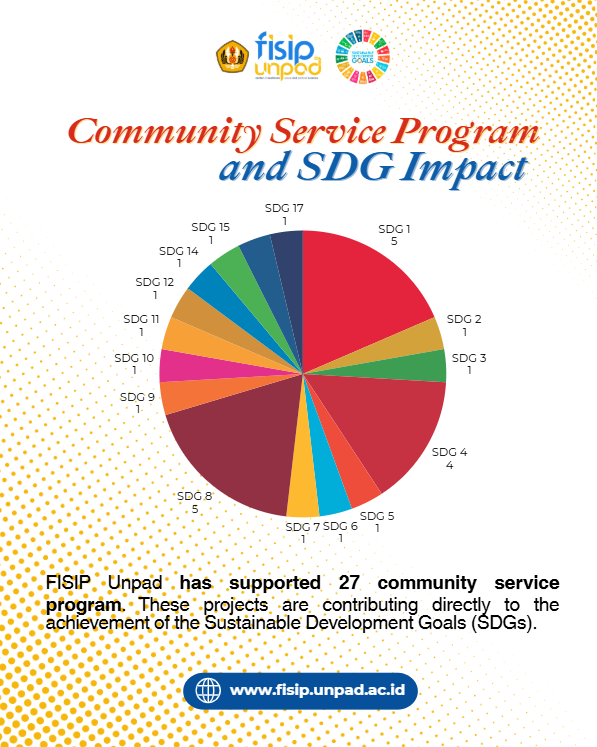
Through the Community Service Program (PPM) 2025, FISIP Universitas Padjadjaran introduces a wide range of strategic initiatives to support the achievement of the Sustainable Development Goals (SDGs). Every activity is carefully designed to deliver tangible impacts through community empowerment, strengthening local economies, preserving cultural heritage, and fostering social and environmental innovation.
In supporting SDG 1 (No Poverty), several integrated programs are implemented, including the Stunting-Free Village Program, which focuses on preventing stunting at the village level; social resilience development to strengthen community capacity against social risks; and social assessment and planning to map problems and design community-based solutions. Villages such as Ciporeat, Girimekar, Jatiendah, and Cilengkrang receive assistance in drafting village regulations on food security to ensure local policies are aligned with sustainable food systems. Furthermore, the Agrotourism Development Program in Baros Village enhances socio-economic capacity, while Community Purchasing Power Enhancement Initiatives are carried out through innovation and pentahelix collaboration in the entrepreneurship sector.
For SDG 2 (Zero Hunger), the Superior Fruit Planting Movement in Cintaratu Village is a strategic step toward establishing an edu-agrotourism zone around the Unpad Pangandaran Campus, creating new economic opportunities while promoting sustainable agricultural education. In addition, the Urban Farming Program is introduced to manage urban environments sustainably and provide access to healthy and eco-friendly food.
Aligned with SDG 3 (Good Health and Well-being), the Social Engineering, Control, and Order Program is implemented to foster harmony and social balance through active community participation. Supporting SDG 4 (Quality Education), several creative initiatives are carried out, including the Bagolo Go Digital Program, which provides digital literacy training to optimize village potential; the Fun Politics Program, an innovative approach to political education through interactive board games; and the formation of the Smart Voters Network (Japedas) to increase women’s participation in the 2024 general election. In addition, Village Regulation Drafting Training is provided to officials in Pasir Mulya, Kecamatan Banjaran, to enhance good governance practices at the village level.
As part of SDG 5 (Gender Equality), the Go Woman Digipreneur Jatinangor Program empowers women through digital entrepreneurship training, creating inclusive opportunities for them to participate actively in technology-driven economic development. In line with SDG 6 (Clean Water and Sanitation), the Participatory Water Resource Mapping Project in Tarumajaya Village involves local communities in ensuring sustainable access to clean water and proper sanitation facilities.
The Urban Farming Program also contributes to SDG 7, supporting urban food self-sufficiency and promoting healthier, environmentally conscious consumption patterns. Meanwhile, SDG 8 (Decent Work and Economic Growth)is strengthened through strategic initiatives, including drafting the Village Tourism Development Master Plan (RIPPDES) 2023–2028 in Wanasari Village, assisting with the governance of the Mandalamekar Tourism Village, and digitalizing Ciwidey’s cultural tourism potential to establish it as an international-standard creative agrotourism destination. Additionally, the program includes Financial Management Training for Tourism-Based MSMEs in Pangandaran and the Halal Tourism Development Project in Bagolo, both aimed at improving the competitiveness of cultural tourism.
Through SDG 9, the Batu Karas Village Paradiplomacy Program positions Batu Karas as a globally connected tourism hub by leveraging international collaboration and optimizing global networks for local development. For SDG 10 (Reduced Inequalities), the Village Cultural Regulation Assistance Program supports the preservation of local identity while reducing cultural and social disparities between regions. In support of SDG 11 (Sustainable Cities and Communities), the “Olah Sebelum Dibuang” Waste Management Program transforms waste into value-added products, contributing to environmental sustainability and improving community livelihoods.
Commitment to SDG 12 (Responsible Consumption and Production) is realized through the Local Potential-Based Agrotourism Development Program, empowering communities to maximize resource utilization while preserving the environment. For SDG 14 (Life Below Water), the Batu Karas Coastal Tourism Development Project positions Batu Karas as a leading maritime tourism destination by optimizing its coastal and cultural resources sustainably to improve community welfare.
Under SDG 15 (Life on Land), the Productive Village Program Based on Local Resources and Culture focuses on developing self-reliant villages by integrating natural resources and traditional knowledge. For SDG 16 (Peace, Justice, and Strong Institutions), the Food Security Regulation Assistance Project in Ciporeat Village ensures that policies are tailored to local needs and priorities. Finally, SDG 17 (Partnerships for the Goals) is achieved through pentahelix collaboration, connecting the government, academia, businesses, media, and local communities to foster innovation, strengthen entrepreneurship, enhance purchasing power, and promote inclusive economic growth.
By integrating innovation, empowerment, and collaboration, PPM 2025 represents the tangible contribution of FISIP UNPAD to addressing global challenges through localized solutions. These programs are designed to accelerate the achievement of the 2030 SDGs Agenda and build a future that is inclusive, resilient, and sustainable.