https://www.scopus.com/pages/publications/85214942114
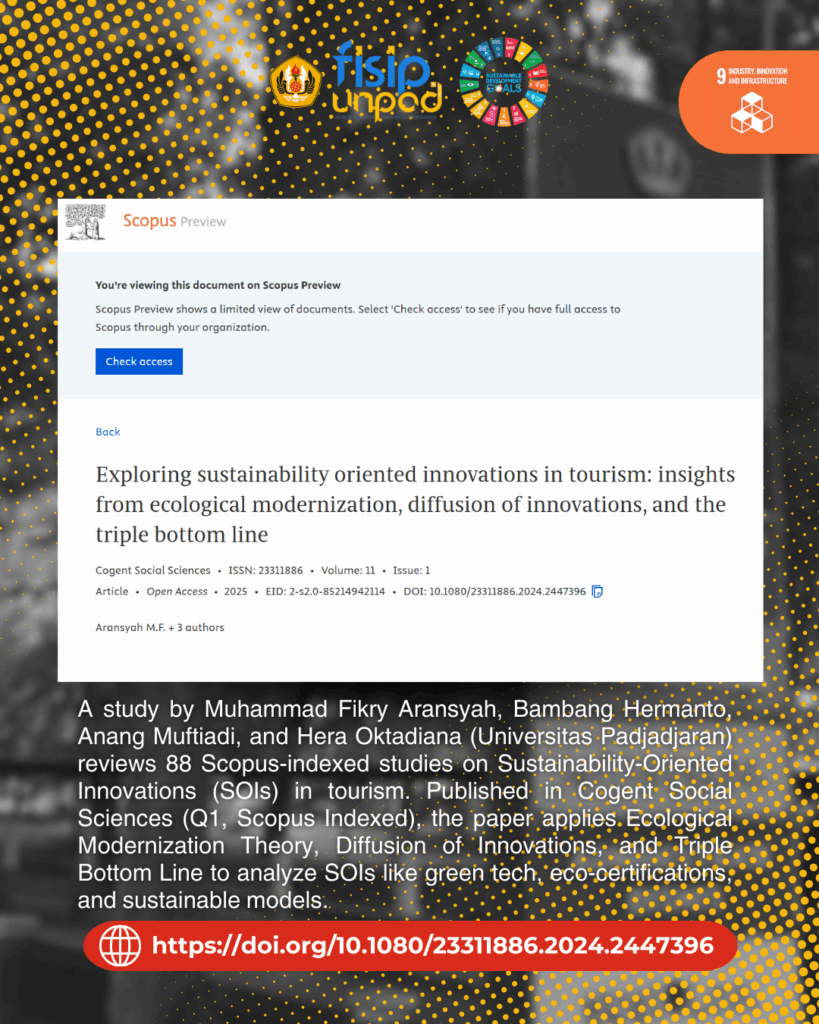
A research team from Universitas Padjadjaran—Muhammad Fikry Aransyah, Bambang Hermanto, Anang Muftiadi, and Hera Oktadiana—has published a significant bibliometric analysis exploring the impacts of Sustainability-Oriented Innovations (SOIs) in the global tourism industry. The study, titled “Exploring sustainability oriented innovations in tourism: insights from ecological modernization, diffusion of innovations, and the triple bottom line,” has been published in Cogent Social Sciences (Volume 11, Issue 1, 2025) and is indexed in Scopus.
By synthesizing 88 studies from the Scopus database, the research provides a holistic view of how SOIs—such as green technologies, eco-certifications, and sustainable business models—contribute to sustainable tourism development. The analysis is framed through three key theoretical lenses: Ecological Modernization Theory (EMT), Diffusion of Innovations (DoI) Theory, and the Triple Bottom Line (TBL).
The findings reveal that SOIs deliver multifaceted benefits: they enhance environmental sustainability through resource conservation and pollution reduction, improve economic performance via cost savings and increased competitiveness, and foster social equity through community involvement and customer satisfaction. The study also identifies critical knowledge gaps, including the long-term impacts of SOIs, the role of green finance, and the effectiveness of eco-labels.
This research offers valuable insights for policymakers to design targeted incentives, for tourism practitioners to adopt sustainable practices for competitive advantage, and for academics to pursue future research in this critical area. The integrated framework proposed by the authors serves as a guide for achieving a balance between economic growth, environmental protection, and social well-being in tourism.
DOI: https://doi.org/10.1080/23311886.2024.2447396