
https://www.scopus.com/pages/publications/85217480949
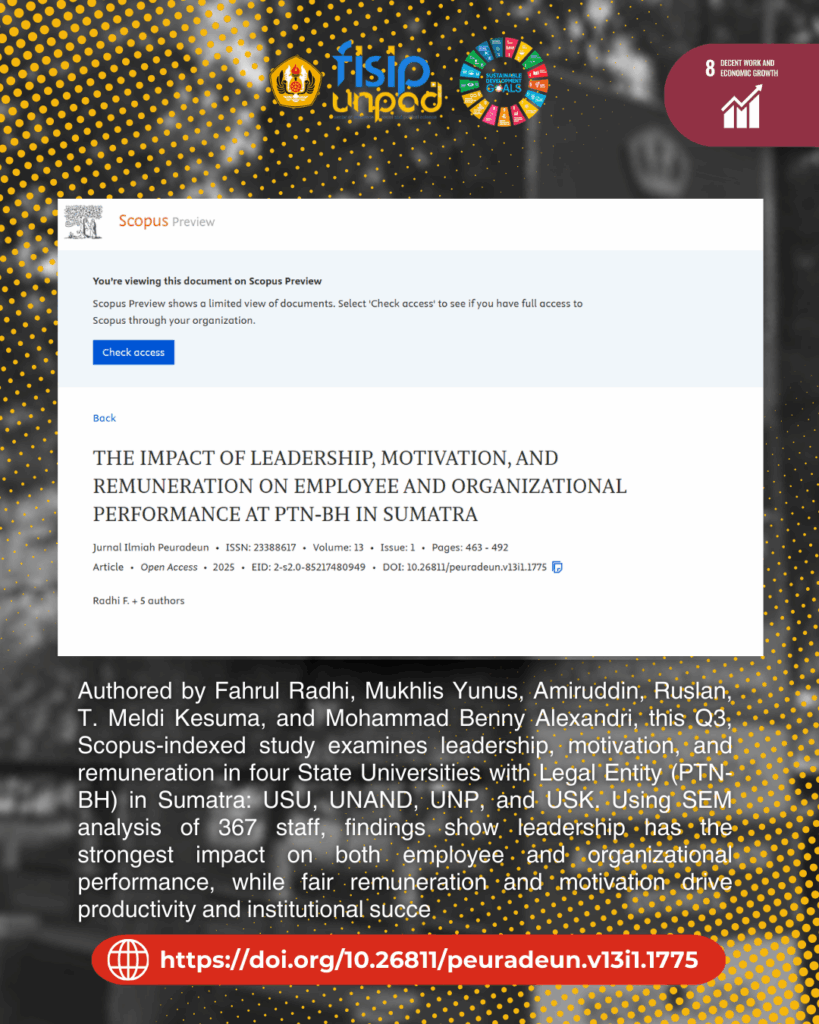
This paper, authored by Fahrul Radhi, Mukhlis Yunus, Amiruddin, Ruslan, T. Meldi Kesuma, and Mohammad Benny Alexandri from the Faculty of Social and Political Sciences, Universitas Padjadjaran, explores the relationship between leadership, motivation, remuneration, and performance at State Universities with Legal Entity (PTN-BH) in Sumatra, namely USU, UNAND, UNP, and USK.
The study involved 367 lecturers and education staff and applied Structural Equation Modeling (SEM) to examine how these factors interact. The results indicate that leadership significantly boosts both employee and organizational performance, emphasizing communication, empathy, and role modeling. Motivation strengthens employee performance but does not directly translate into organizational success unless mediated by individual outcomes. Meanwhile, remuneration through fair compensation and incentive systems was found to be a major contributor to productivity and organizational growth. Importantly, employee performance accounts for 41% of organizational performance, underscoring the centrality of human capital in institutional success.
This research directly aligns with Sustainable Development Goal 8: Decent Work and Economic Growth, which emphasizes productive employment, fair remuneration, and sustained economic growth. By showing that adaptive leadership, motivational strategies, and transparent reward systems drive higher performance, the study reinforces how educational institutions can create decent work environments that empower employees and enhance institutional competitiveness. Moreover, the focus on improving work quality in PTN-BH reflects the broader mandate of SDG 8 to promote inclusive and sustainable economic growth through stronger governance and human resource development.
Through its findings, the article contributes not only to academic literature but also provides actionable insights for policymakers and higher education leaders in Indonesia. Strengthening employee capacity and ensuring equitable incentives are key to fostering sustainable institutional growth, an agenda that sits at the heart of SDG 8.
Discover more about this impactful research : https://www.scopus.com/pages/publications/85217480949