https://www.scopus.com/pages/publications/85184407975
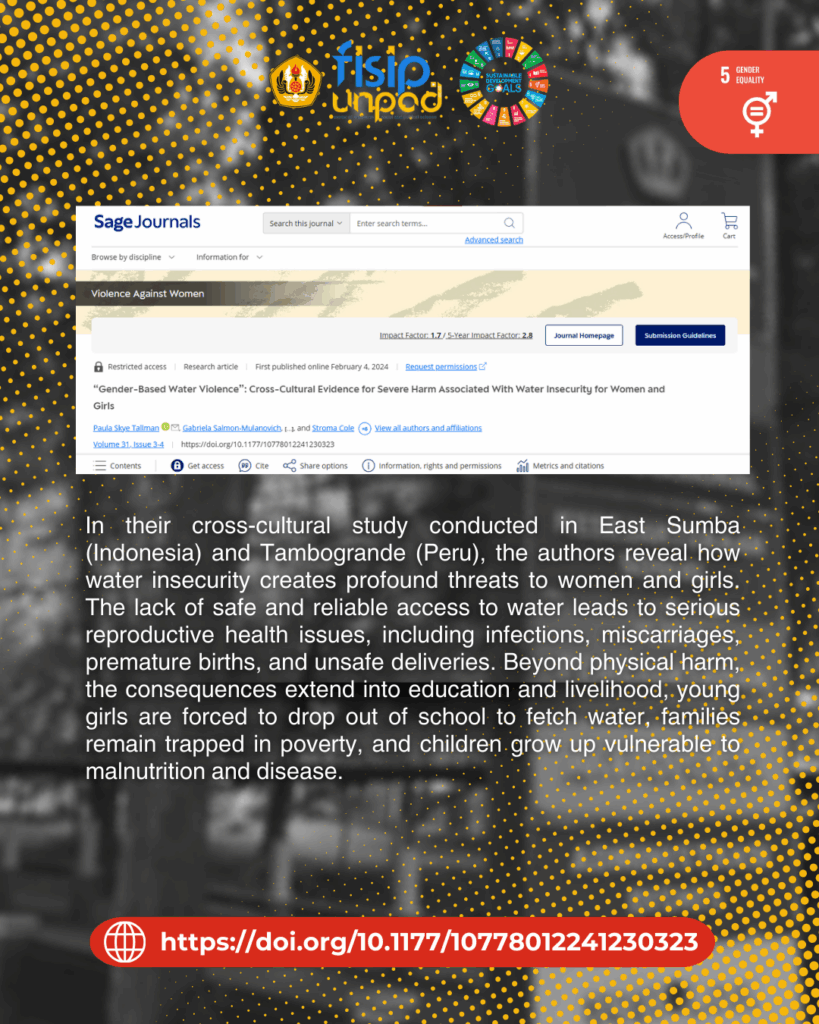
Water is one of humanity’s most essential sources of life. It is woven into our daily existence, sustaining health, nourishment, and dignity. Across cultures, water also carries symbolic weight as a sign of purity, renewal, and cultural tradition. Yet research reveals a harsher reality behind this universal resource. The article “Gender-Based Water Violence: Cross-Cultural Evidence of Severe Harm Associated with Water Insecurity for Women and Girls” by Paula Tallman, Gabriela Salmon-Mulanovich, Nicholas Archdeacon, Aman Kothadia, Luis Lopez Flores, Keren Castañeda, Shalean Collins, Binhayati Rusyidi, and Stroma Cole uncovers this hidden dimension through fieldwork conducted in Peru and Indonesia.
The study, carried out in Tambogrande (Peru) and East Sumba (Indonesia), documents how water scarcity, or what researchers term water insecurity, creates profound threats to women’s reproductive health. Participants reported vaginal infections, miscarriages, premature births, and even uterine prolapse. Beyond the physical toll, the consequences spill into the social sphere: young girls missing school because hours are consumed by fetching water, families trapped in cycles of poverty, and children facing malnutrition and disease.
The authors define this phenomenon as gender-based water violence. It is a form of violence that does not manifest through blows or shouts but through slow, structural violence embedded in cultural norms and social expectations. It erodes lives silently, day after day, stripping away opportunities and constraining futures.
This research makes it clear that equal access to water is inseparable from the global pursuit of gender equality. When women are forced to bear health risks, when girls lose their right to education, and when hidden forms of violence arise from water insecurity, the promise of SDG 5: Gender Equality remains unfulfilled. Guaranteeing safe and fair access to water is not only a practical necessity but also a foundation for protecting women’s dignity, strengthening their role in society, and advancing justice across generations.
Learn more in the published article: https://doi.org/10.1177/10778012241230323