
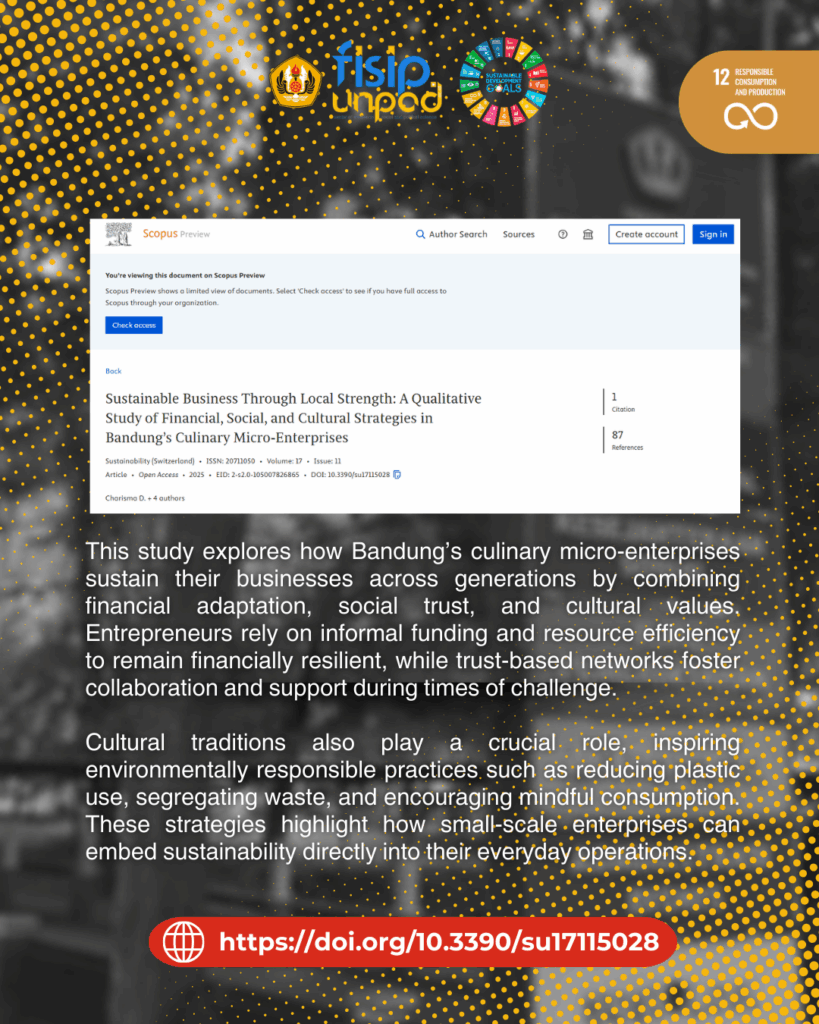
https://www.scopus.com/pages/publications/105007826865
Sustainability has become an essential concern not only for large corporations and governments but also for small-scale enterprises that form the backbone of local economies. In Indonesia, culinary micro-enterprises play a vital role in providing livelihoods, preserving culture, and serving communities. Yet, their ability to endure across generations often depends on how they balance financial resilience, social networks, and cultural values.
This paper, “Sustainable Business Through Local Strength: A Qualitative Study of Financial, Social, and Cultural Strategies in Bandung’s Culinary Micro-Enterprises”, was written by Dinna Charisma, Bambang Hermanto, Margo Purnomo, Tetty Herawati, and Anne Charina, and published in Sustainability (Scopus-indexed). The study explores how culinary micro-enterprises in Bandung sustain their businesses through financial adaptation, trust-based social networks, and cultural values that shape daily operations.
The findings reveal that entrepreneurial finance is often built on informal funding and resource efficiency, social trust fosters resilience and collaboration, and cultural values inspire environmentally responsible practices such as reducing plastic use, waste segregation, and encouraging mindful consumption. These strategies highlight that sustainability is not only achievable through large-scale policies but also through community-driven practices rooted in local wisdom.
Importantly, these insights align with Sustainable Development Goal 12 (Responsible Consumption and Production), which emphasizes reducing waste, promoting efficient resource use, and fostering sustainable consumption patterns. By embedding responsibility and care for the environment in their business practices, Bandung’s culinary micro-enterprises demonstrate how grassroots entrepreneurship can make meaningful contributions to global sustainability goals.
Discover more about this impactful research: https://www.scopus.com/pages/publications/105007826865